A detailed Xactimate estimate is much more than a simple list of repair costs. It is a critical component of claim documentation that can significantly influence how the negotiation process unfolds once the estimate is submitted to the carrier. If the scope is not fully identified, the measurements are incorrect or the key items are missed, and the estimate may not accurately reflect the extent of damage to the property. When that happens, the public adjuster cannot leave a better settlement on the table and find themselves expending more time on revisions, follow-ups and carrier pushback that could have been avoided.
This is why a full review of the estimate should be a standard in every public adjusters claim process management before any estimate is sent to the insurance carrier. A rushed or half-baked estimate does not save time in the long run. More often it adds extra back-and-forth that slows the claim down and delays the client’s settlement.
NEOMIND Global is exclusively providing Xactimate estimation services and public adjuster back-office support to public adjusters. Our Remote Xactimate Estimators give you accurate, carrier-ready estimates with accurate damage scoping, correct line-item pricing and clean documentation, all of which is internally quality reviewed before it ever hits your desk. Our structured review process identifies missed scope, inconsistent quantities, pricing variances and documentation gaps before they become roadblocks during negotiations.
An Xactimate estimate review is a structured quality assurance process to review an estimate for scope, quantities, pricing, taxes, depreciation, documentation and consistency. This isn’t a quick glance at the totals. A thorough review checks the estimate in detail, and compares it line by line with the actual documentation collected during the inspection.
The aim here is not to inflate the estimate. This is to ensure the estimate accurately reflects the documented damage and the work reasonably necessary to restore the property. It is always good to have a second set of eyes, because individual components, on a large or complex claim, can be missed by even the most experienced estimator, and this can be especially true with multiple trades, rooms or types of damage. That’s why NEOMIND does internal quality control on all files before delivery. This process is designed to speed up carrier approval and minimize revision cycles.
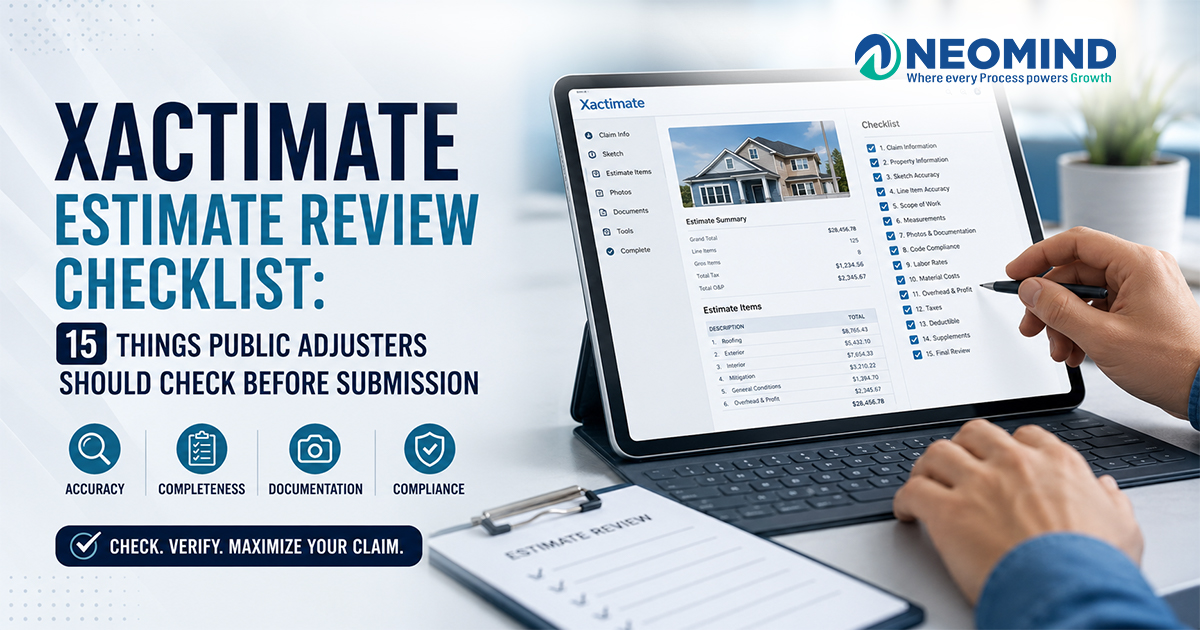
Use this checklist before you submit a property damage estimate. Each of the points below is a place where mistakes, omissions or inconsistencies are apt to occur and where a careful second look is usually rewarding.
Start with the basic claim information. Small errors here are easy to overlook but can cause real delays once the estimate gets to the carrier. Check the following:
1. Property address
2. Date of loss
3. Claim number
4. Insured name
5. Estimate date
6. Estimate version
7. Cause of loss
8. Applicable rooms and areas
9. Correct estimate description
Mistakes in the basic information can lead to unnecessary delays and questions later down the road in the claim process. For example, an incorrect date of loss, or an outdated version of an estimate might prompt a request for clarification, which can delay the process by days.
Go through the estimate with all available inspection notes, photographs, videos, moisture readings, contractor documentation and other claim records. This step is to ensure that nothing noted during inspection was left out of the final scope. The estimate should tell the complete story of the documented damage, not just the most visible part of it.
Review every dimension used in the estimate, including:
1. Length
2. Width
3. Height
4. Floor area
5. Wall area
6. Ceiling area
7. Openings
8. Linear measurements
9. Waste factors, where applicable
This is one of the most important steps in the review process, because incorrect measurements can impact more than one line item simultaneously. One wrong wall measurement can throw off the drywall, paint, baseboard, and flooring quantities all at once, so it’s worth taking the time to double-check the measurements against the original sketch or floor plan rather than assuming they transferred correctly.
Photo documentation should support the scope being claimed. During the review, compare the estimate with the photos and check:
1. Is the damaged area clearly visible?
2. Does the photo support the claimed quantity?
3. Are the affected materials identified?
4. Are adjacent areas documented?
5. Are before-and-after conditions available where relevant?
Well-organized photo documentation also makes it easier for the carrier to review the estimate and reduces the chances a carrier will ask for more proof before approving a line item. This is a fundamental part of the documentation support for public adjusters on every file, from photo organization to full file management, so that there is clear photo support behind every line item in the estimate.
One of the most common reasons an estimate is incomplete is a missed line item. Look beyond the obvious repair and think through everything that logically follows from it.
For example, if drywall is being replaced, consider whether the documented scope also requires related work such as:
1. Insulation removal and replacement
2. Texture
3. Primer
4. Paint
5. Baseboard
6. Flooring
7. Detach and reset
8. Protection
9. Debris removal
The loss conditions and applicable requirements should always support the final scope, not just be added for convenience or habit. A second review, line by line, can help to catch these omissions before submission – catching the small items that seem individually minor, but collectively add up to a meaningful gap in the estimate.
Matching can become an important issue when only part of a continuous finish is damaged. Review potentially affected materials such as:
1. Flooring
2. Roofing
3. Siding
4. Paint
5. Cabinets
6. Countertops
7. Wall finishes
When reviewing matches, determine whether the documented repair scope addresses the affected areas and if any policy, code or other applicable requirements are involved. This is often one of the more nuanced parts of an estimate as the answer varies greatly on product, availability and amount of damage.
Don’t add matching items just because a material looks different. They must be supported by the facts of the claim and applicable requirements. Documentation should clearly state why matching is necessary.
Some repairs may include code or ordinance requirements in addition to a basic like-for-like replacement. Depending on the property and the loss, review the documented scope for items such as:
1. Updated building materials
2. Required insulation
3. Electrical requirements
4. Plumbing requirements
5. Roofing requirements
6. Vapor barriers
7. Safety requirements
8. Accessibility requirements
Documentation applicable to code-related work should be the support rather than a generic allowance. If the carrier pushes back on these items, referencing the specific code section or local ordinance in the file makes the estimate much easier to defend.
The estimate should accurately identify the materials being repaired or replaced. Check details such as:
1. Material type
2. Grade
3. Size
4. Thickness
5. Manufacturer
6. Product line
7. Finish
8. Installation method
9. Quality level
For example, if more specific information is available, a roof estimate should accurately reflect the documented roofing system instead of a generic description. Vague material descriptions are one of the easiest things for a carrier to challenge, so specificity here makes the estimate a lot better.
Materials are only one part of the repair. Review whether the estimate accounts for the labor and installation activities required by the documented scope, which may include:
1. Removal
2. Installation
3. Detach and reset
4. Surface preparation
5. Finishing
6. Cleaning
7. Hauling
8. Equipment
9. Access requirements
We want to make sure the estimate includes the whole process of the repair, and not just the replacement material. It is easy to price the material correctly but underquote the labor needed to actually get it installed, especially if the damaged area is hard to access.
Property-damage work often involves accessing the damaged area, and that access can be costly in itself. Verify that the documented work requires:
1. Moving furniture
2. Moving contents
3. Covering unaffected areas
4. Protecting flooring
5. Protecting cabinets
6. Protecting furniture
7. Temporary removal and reset of items
The evaluation of these activities shall be based on the actual conditions and work required on the property and shall not be assumed or glossed over as secondary to the main repair.
Check all pricing information used in the estimate, including:
1. Correct price list
2. Applicable regional pricing
3. Material costs
4. Labor costs
5. Equipment costs
6. Sales tax
7. Taxable and non-taxable items
The price will vary depending on the price list and the date of the estimate in force, therefore it is important that the estimate and the supporting documents are consistent. An outdated price list or one that’s tied to the wrong region is a quiet mistake that can affect the accuracy of the whole estimate, without being obvious at a glance.
Certain materials require material waste allowances due to unavoidable waste of material during the installation process. Where applicable, confirm that the correct waste factor has been applied, for example with:
1. Roofing materials
2. Flooring
3. Drywall
4. Other cut-to-fit materials
The waste factor should be reasonable and you should have a scope for it. It should not be applied blindly to every line item without regard to whether it really applies.
For larger or more complex projects, consider whether Overhead & Profit (O&P) is warranted based on the circumstances of the project and the services required.
O&P should not be an automatic add-on to every estimate. Its use should be evaluated on a project-by-project basis, considering the trades involved and other claim considerations, as its inclusion without justification can undermine the credibility of an otherwise well-documented estimate.
If depreciation applies to the estimate, review:
1. Depreciation percentages
2. Depreciation amounts
3. Recoverable depreciation
4. Non-recoverable depreciation
5. Applicable policy provisions
6. Replacement cost versus actual cash value considerations
We have seen depreciation treatment vary by policy and claim circumstances and it should always be scrutinized against the relevant documentation, not used as a default calculation carried over from a previous file.
Before you submit, make sure the estimate and supporting documents tell a consistent story. A well-organized claim file should allow a reviewer to follow the sequence of events leading up to the claim:
What happened → what was damaged → what needs to be repaired → how much the repair will cost → why the requested scope is needed.
Review the file for:
1. Estimate
2. Photos
3. Inspection notes
4. Measurements
5. Contractor documentation
6. Invoices or receipts, where applicable
7. Policy references
8. Code documentation, where applicable
9. Previous carrier estimates
10. Supplement documentation
A well-constructed file can help the negotiation process go a lot more smoothly, because a carrier reviewer who can follow the story without having to dig for missing pieces is much more likely to move quickly toward approval. This is the kind of claim file review and quality control that a dedicated back-office team is built to deliver on every file.
Before sending an estimate to the carrier, confirm:
1. Claim information is correct
2. The entire documented damage is included
3. Measurements are accurate
4. Time-stamped photographs support the scope
5. Potential missed line items have been reviewed
6. Matching and continuity issues have been evaluated
7. Applicable code requirements have been considered
8. Material specifications are accurate
9. Labor and installation components are complete
10. Protection and manipulation requirements are addressed
11. The correct price list is being used
12. Taxes and pricing are accurate
13. Waste factors are appropriate
14. O&P has been evaluated where applicable
15. Depreciation has been reviewed where applicable
16. Supporting documentation matches the estimate
Even if an experienced estimator has prepared the estimate, a second review can often find details that were missed during the first pass. What an estimate review is valuable for is not adding more line items. It’s about making sure the estimate is accurate, complete, consistent and well-documented before it ever gets to the carrier, which makes the negotiation process easier for everyone.
This is especially helpful for public adjusters who are handling a large volume of claims, such as in the event of a catastrophe (CAT) when claims volume skyrockets and there is very little time for internal teams to perform deep quality control. This is exactly where Property Claims Outsourcing to a dedicated back-office estimating team can make the most difference, enabling adjusters with the capacity to maintain quality even when file counts spike.
NEOMIND Global is a Public Adjusting BPO Company offering Xactimate and Symbility estimating, claims operations support, and end-to-end Back Office Support for Public Adjusters. It is created to help you manage the administrative and technical workload behind every property claim without sacrificing accuracy or turnaround time.
NEOMIND is a hands-on claims operations and growth partner, plus Outsource Xactimate Estimate Writing. Our Public Adjusting Virtual Assistance covers the entire life of a claim including:
1. Lead Generation and Management: Lead generation for public adjusters, organized lead tracking, and higher conversion from prospects to active claims
2. Documentation and File Prep: Complete claim file organization, organized photo documentation, and carrier-ready submissions
3. Xactimate and Symbility Estimating: Accurate estimates prepared by a dedicated team of estimators, backed by internal quality review before delivery
4. Supplements and Negotiation Support: Supplement preparation, line-by-line carrier estimate comparison, and support for stronger settlement negotiations
5. Complete Claim Process Management: Coordination from intake through final settlement, with Carrier coordination for public adjusters and stage-by-stage tracking
6. Carrier and Client Communication: Coordinating with carriers, homeowners, and contractors to keep claims moving with consistent follow-ups
7. Inspection Scheduling and Coordination: Inspection scheduling for public adjusters, tracking reports, and organizing inspection documentation and updates
8. PA Forms and Authorization Handling: Contracts, letters of representation, e-signatures, and faster client onboarding and claim setup
9. Bookkeeping and Invoicing: Accurate financial records, invoicing, payment tracking, and clear reporting on active claims
A good Xactimate estimate should be complete, defensible, well documented, and consistent with the actual scope of damage. This checklist isn’t a replacement for the judgment of an experienced public adjuster, but it does give that judgment a structured process to work within, one that catches the small oversights before they become carrier objections.
Public adjusters should run a Xactimate estimate review checklist before submitting the estimate to catch missed scope, measurement errors, documentation gaps and other problems before they become obstacles during claim negotiations.
With the increasing volume of claims, a structured review process supported by an experienced Public Adjuster claims handling support team can assist in keeping estimates moving while not sacrificing attention to detail.
Need help with reviewing or preparing Xactimate estimates? Contact NEOMIND Global and see how our Xactimate writing services and Virtual Assistance can help your team handle more claims efficiently.
Let’s Talk – Get a Free Consultation
Serving Public Adjusters across the United States with expert estimation, back-office support, and business growth solutions.
NEOMIND helps public adjusters across the entire United States by providing expert Xactimate Estimating services, comprehensive supplement support, targeted Lead Generation and Lead Management, efficient Back-office Operations, and customized Insurance Claim Management solutions designed specifically to improve operational efficiency and long-term business growth.
Whether you’re an independent public adjuster or a growing firm, our experienced team is ready to support your success.
📞 Let’s Talk for a Free Consultation: +1 469-329-1088
🌐 Visit: https://neomindglobal.com/public-adjuster-virtual-assistance/
📧 Email: info@neomindglobal.com
👉 Partner with NEOMIND today to streamline your estimation process, generate high-quality leads, and grow your public adjusting business with maximum efficiency.